

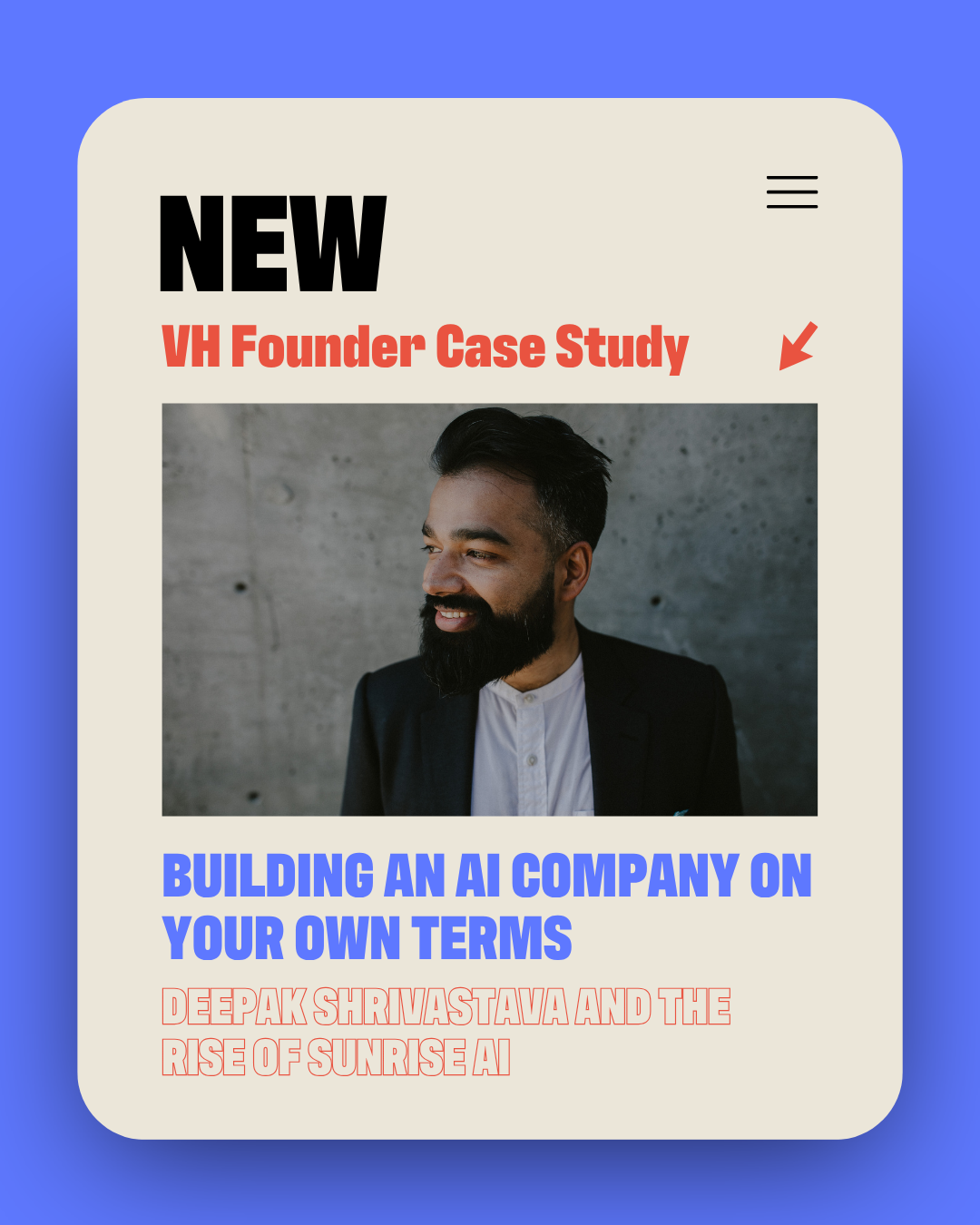
“You’ll have multiple at-bats. Don’t make your first startup the hill you die on.” - Deepak Shrivastava, Founder of Sunrise AI
For many founders, the startup journey is defined by relentless hustle, venture capital milestones, and the pursuit of a massive exit.
For Deepak Shrivastava, success looks a little different.
Shrivastava is building an ambitious artificial intelligence company, Sunrise AI, working with major enterprise organizations and tackling complex problems around secure AI deployment. Unlike many founders chasing their first major career milestone, entrepreneurship for him comes after years of professional success.
Before Sunrise, Shrivastava had already experienced an expansive career across finance and technology, from Morgan Stanley to early-stage startups. Yet the defining shift in how he thought about success didn’t come from a promotion or a business milestone. It came from becoming a parent.
Today, Shrivastava sees his startup as one part of a larger life he’s intentionally building.
“I already feel successful,” Shrivastava said. “I get to build something exciting while still being there for
my family.”
That philosophy of balancing ambition with perspective now shapes the way he builds companies.
And, in many ways, his journey reflects a broader shift happening across the startup ecosystem: founders redefining what this magical word “success” truly looks like.
Shrivastava didn’t initially plan to become a founder. Born in the Bronx and raised in Queens, he originally studied engineering and imagined a career as a teacher. But the reality of student debt quickly changed that plan.
Like many graduates, Shrivastava found himself balancing long-term aspirations with more immediate financial realities. Teaching had been the goal, but paying off loans and supporting family meant prioritizing stability and income first.
“The best paying job I could get was investment banking,” he recalls.
What started as a practical decision quickly turned into a formative chapter of his career. After graduating, Shrivastava joined Morgan Stanley, where he spent several years working in investment banking across New York, Los Angeles, San Francisco, and Hong Kong. Covering the hospitality industry—including the booming casino markets in Macau and Singapore—he developed a deep understanding of global markets and large-scale business strategy.
Over time, Shrivastava began to feel a pull toward something different. Once he had paid off his student loans and helped support his family, he made a decision that surprised many around him: he walked away from banking entirely.
“I left cold turkey and took a year off to figure out what I actually wanted to do,” Shrivastava said. That year turned out to be one of the most formative periods of his career.
During his break from finance, Shrivastava unexpectedly found himself running a DJ talent agency, booking performers from Las Vegas and Los Angeles for venues across Asia.
“It was fun,” Shrivastava started, “but I realized pretty quickly I didn’t want to be the 40-year-old guy in the club.”
The experience was a reminder that careers rarely move in straight lines. Sometimes the roles that weren’t part of the original plan offer the clearest perspective on what comes next.
Eventually, Shrivastava joined Dropbox during its early growth phase, when the company was scaling rapidly from roughly 50 employees to hundreds. Being inside a fast-growing technology company at that moment changed how he saw the world of work.
Startups suddenly felt less like abstract Silicon Valley stories and more like something tangible; something Shrivastava could build himself.
The broader startup ecosystem was experiencing explosive growth throughout the 2010s, with venture capital investments surging, and entrepreneurship becoming an increasingly visible career path for ambitious builders. The reality behind startup success stories, however, was (and remains) far less glamorous. According to data from Startup Genome, roughly 90% of startups ultimately fail, often after years of navigating uncertainty before reaching product-market fit. The barriers are even higher for founders from overlooked backgrounds, with BIPOC founders receiving only about 2–3% of total venture capital funding in the United States, despite representing a much larger share of the population.
For aspiring founders of color, building a startup often means navigating both the universal risks of entrepreneurship and structural barriers within the venture ecosystem itself. Shrivastava would experience many of those realities firsthand as he began building his own companies.
Shrivastava’s first ventures were in travel technology. While both companies eventually exited, the journey was far from smooth. Like many founders building in sectors directly impacted by global events, he experienced firsthand how quickly momentum can unravel. At the height of the pandemic, when travel came to a near standstill, his startup saw nearly 90% of its revenue disappear almost overnight. What had once felt like a high-growth, promising business suddenly became a question of survival.
“I remember thinking, how am I almost 40 years old and don’t know how I’m going to pay rent?”
Shrivastava recalled.
Moments like that are rarely captured in startup headlines, but they’re deeply familiar to many founders—especially those building without large financial safety nets or institutional backing. Behind the narratives of innovation and scale are real tradeoffs: financial uncertainty, personal sacrifice, and the pressure of responsibility not just to a company, but to a family. For Shrivastava, that period became a turning point.
It forced him to reevaluate not just how he builds companies, but why. While many startup narratives celebrate risk-taking at all costs, Shrivastava takes a more grounded view: one that prioritizes sustainability, perspective, and the understanding that a single company does not define a founder’s entire career.
“You’ll have multiple at-bats,” he said. “Don’t make your first startup the hill you die on.”
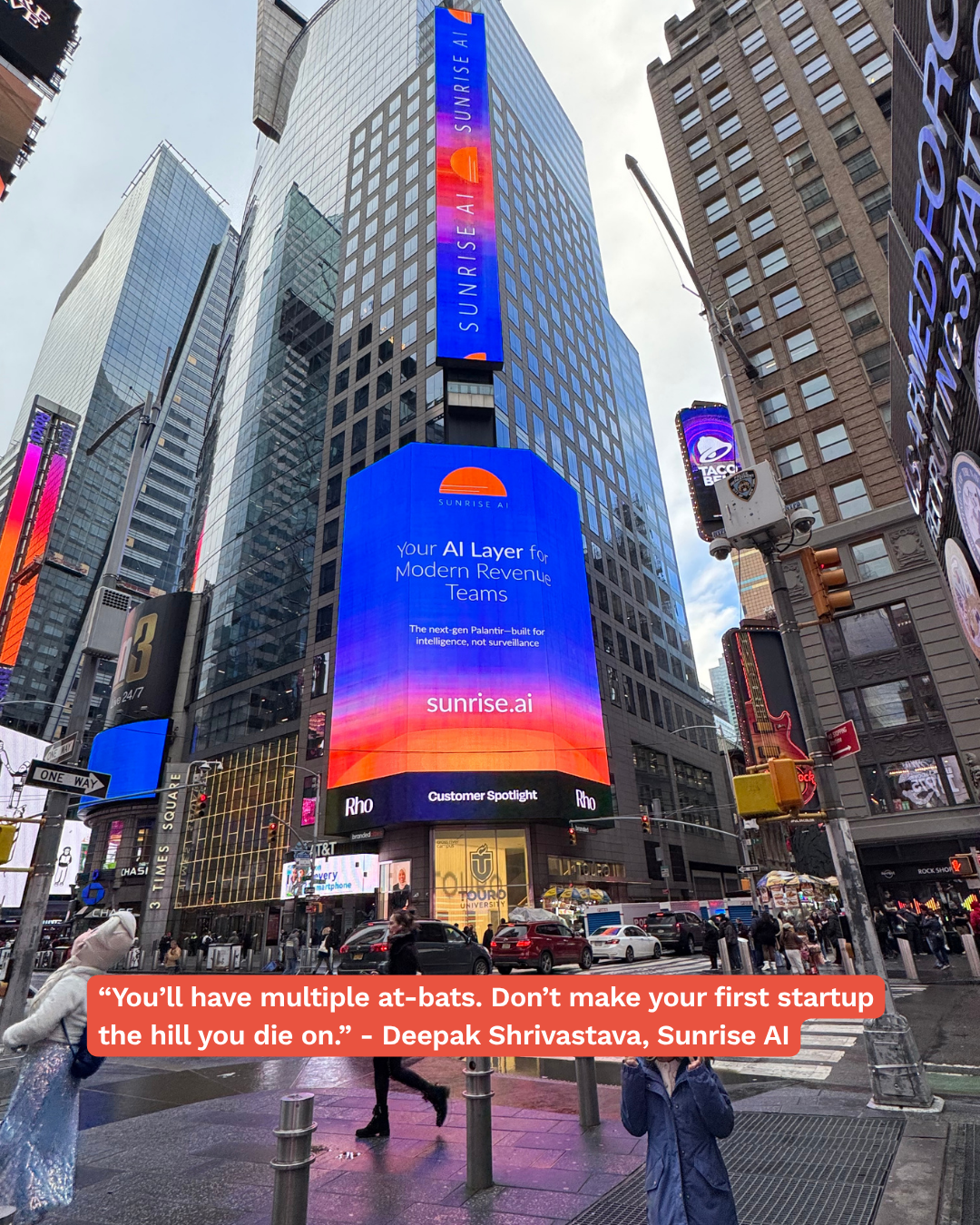
Shrivastava eventually launched Sunrise AI after briefly stepping away from startups to spend time as a stay-at-home dad.
Initially incubated within a venture fund, Sunrise started as a machine learning platform designed to improve credit scoring models; an effort aimed at addressing biases within traditional financial systems.
Early results were promising, but Shrivastava found that the market wasn’t ready to pay for the product. Instead of pushing forward with a weak signal, he began speaking with enterprise leaders across industries, asking one simple question: What problems are you struggling with?
Over the course of hundreds of conversations, one theme emerged again and again: revenue teams inside large companies were drowning in data, but lacked the intelligence systems needed to turn that data into
better decisions.
That insight led to Sunrise’s pivot, one that Shrivastava took with ease.
“Deepak came into the VHNYC fellowship with one idea in the credit score space, and that idea changed a lot over time,” said Co-Founder and General Partner of Visible Hands, Justin Kang. “What impressed me was how he handled that. He didn't dig in or get defensive about it. He listened to customers, asked hard questions, and let the answers actually move him. That willingness to learn and adapt is what really stood out.”
Today, the company builds AI-powered infrastructure for enterprise teams, embedding intelligent agents into organizations’ existing technology stacks to help optimize everything from pricing strategy to customer retention.
“Enterprise companies manage billions in revenue,” Shrivastava said. “But the decision-making behind that revenue often still relies on spreadsheets.”
Sunrise aims to change that.
Shrivastava is building Sunrise at a moment when artificial intelligence is reshaping the global economy.
Over the past few years, AI investment has surged dramatically, with global venture funding into AI startups reaching tens of billions of dollars annually, exceeding $100 billion in 2024 alone, according to CB Insights. Companies across every industry have been racing to adopt AI-driven tools and infrastructure, with what was once a frontier technology now quickly becoming table stakes.
Despite the hype, many companies struggle to translate AI tools into real business outcomes.
“Everyone has dashboards,” Shrivastava explained. “What they need is intelligence that actually acts on
the data.”
That’s where Sunrise’s technology comes in. Rather than simply providing analytics, Sunrise embeds AI directly into operational workflows, enabling companies to identify opportunities and take action automatically.
One example is the company’s work with OpenTable, where Sunrise analyzes massive datasets to help sales teams identify the most valuable restaurant partners and prioritize outreach.
“It’s not a dashboard or a copilot,” Shrivastava said. “It’s an intelligence backbone.”
A key difference between Sunrise and many venture-backed startups is how it has been financed.
Instead of raising large funding rounds immediately, Sunrise focused on building a sustainable business
model early.
The result: the company became “default alive,” a startup term meaning a business can survive on its existing revenue without needing additional outside capital.
That financial independence has given Shrivastava a different perspective on growth.
“When you’re burning cash, every decision is about survival,” he said. “But when a company has financial stability, founders can make well thought-out, longer-term decisions about product, customers, and hiring.”
According to Shrivastava, another important piece of Sunrise becoming a successful startup is his cofounder, Jason Uechi.
Uechi didn’t look like the stereotypical Silicon Valley CTO, and the uniqueness of his background and character was reflective of Shrivastava’s.
“He’s a Hawaiian guy with a PhD in music composition,” Shrivastava said. “He challenged some of my assumptions about what an AI engineer looks like. He wasn’t what I was expecting a ‘startup guy’ to be, and yet he exceeded those expectations and continued to show up entirely as himself. I think that’s important whether running a company or just living your day-to-day life.”
Uechi had spent decades teaching himself artificial intelligence and machine learning. His technical expertise and creative thinking made him an ideal partner for building Sunrise’s technology. Together, they built a complementary leadership structure: Shrivastava focusing on strategy and enterprise relationships, while Uechi leads engineering and product development.
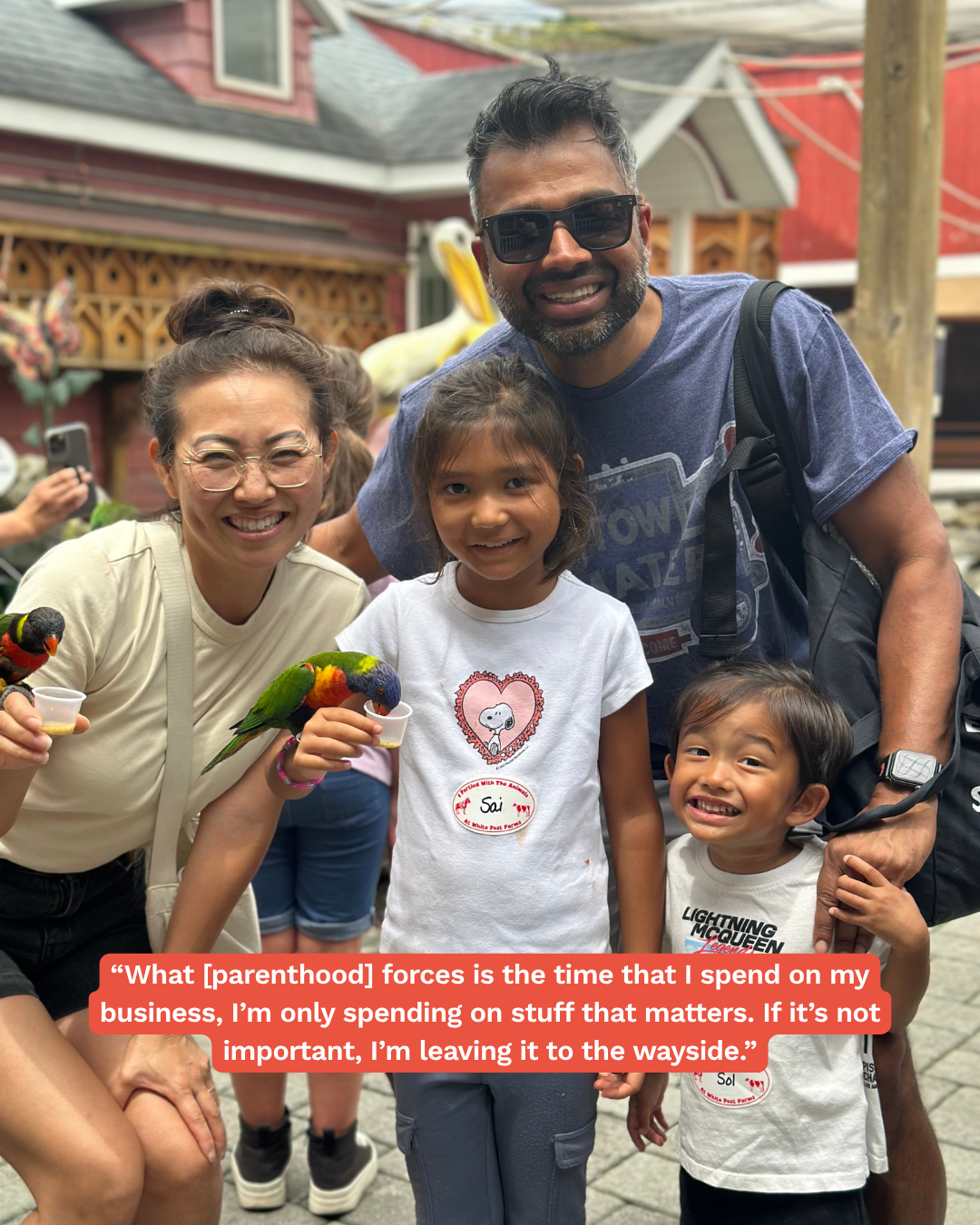
Perhaps the most defining part of Shrivastava’s journey isn’t just the companies he’s built, but how he’s chosen to build them alongside a full, present family life. Parenthood didn’t just add responsibility; it fundamentally reshaped how he operates as a founder.
“When you have kids, your time becomes extremely limited,” he said. “You can’t just work on
everything anymore.”
The startup ecosystem often glorifies endless hustle, filling days with meetings, emails, and marginal tasks. In contrast, Shrivastava became ruthlessly focused on what actually moves the business forward.
“What [parenthood] forces is the time that I spend on my business, I’m only spending on stuff that matters,” he explained. “If it’s not important, I’m leaving it to the wayside.”
The result is a level of clarity and efficiency that many founders struggle to achieve. Every hour has a purpose. Every decision carries weight.
At the same time, Shrivastava is intentional about being fully present at home, showing up for school drop-offs, family routines, and everyday moments that are easy to miss in the early stages of building a company.
“I want to truly and fully be there for my family,” he said. “I want to be a good partner. I want to be a good dad.”
That perspective stands in contrast to broader workplace trends. Research from Pew Research Center shows that working parents—especially fathers—often face competing expectations between career ambition and family involvement, while mothers, in particular, are frequently perceived as less committed to their careers after having children.
For Shrivastava, those assumptions don’t hold. If anything, becoming a parent sharpened his edge as
an operator.
“Becoming a parent makes you super cutthroat about what matters,” he said. “You just don’t have time for things that don’t move the needle.” Contrary to startup mythology, he believes parenthood hasn’t slowed him down; it’s made him better.
“You become incredibly efficient,” he said. “You learn how to focus in a way you just don’t before.”
And in many ways, that clarity has become a competitive advantage—not just for him personally, but for the company he’s building.
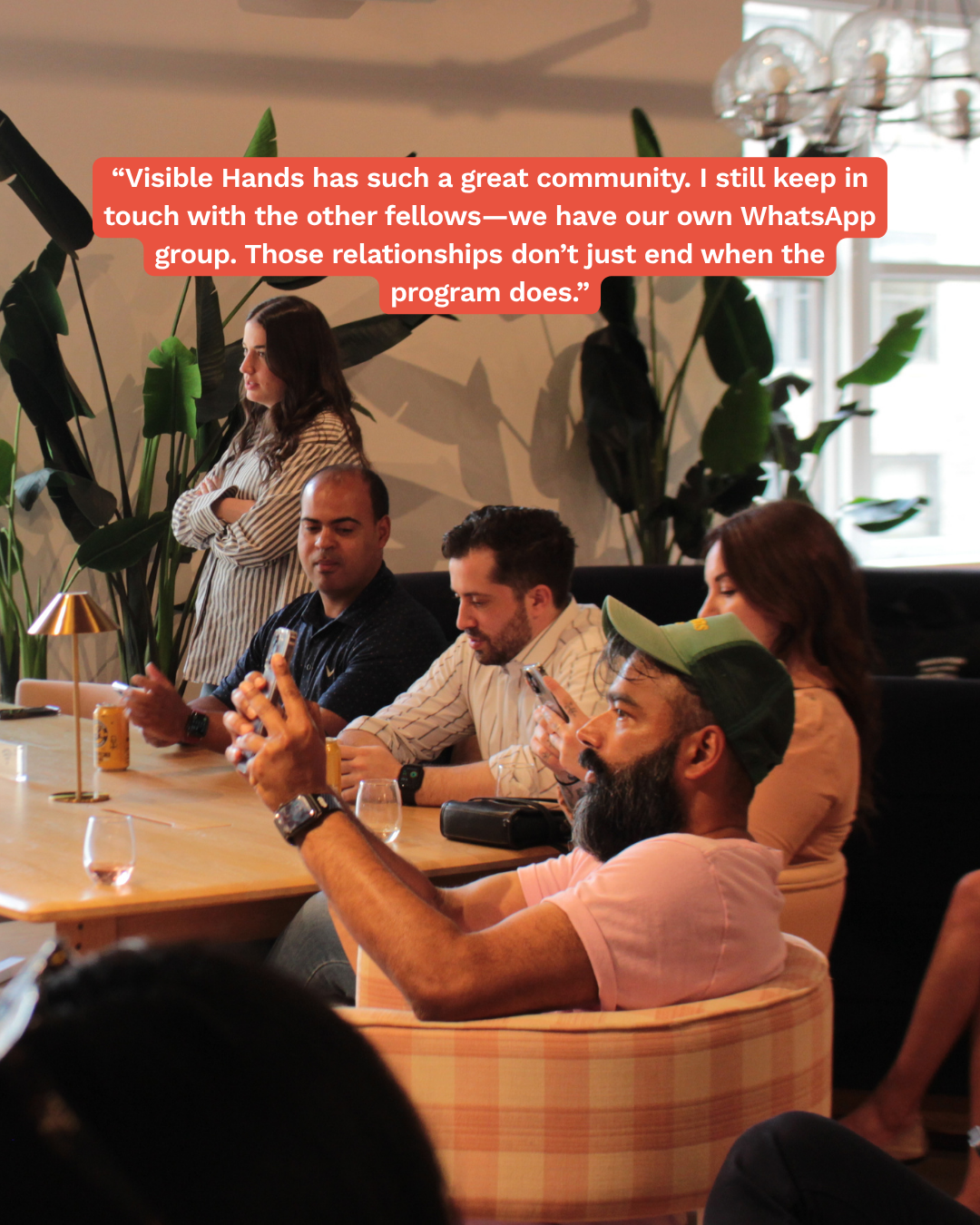
While building Sunrise, Shrivastava also became part of Visible Hands’ NYC ecosystem through its VHNYC Fellowship, a program designed to uplift early-stage founders from overlooked backgrounds with capital, mentorship, and hands-on support.
For him, the value of the program went far beyond funding.
“Visible Hands has such a great community,” Shrivastava said. “I still keep in touch with the other fellows—we have our own WhatsApp group. Those relationships don’t just end when the program does.”
In an industry where access to networks often determines opportunity, that sense of continuity matters. Founders aren’t just given resources—they’re surrounded by people who understand the realities of building from the ground up, and at Visible Hands, who also understand those realities while coming from different perspectives than those typical in the VC space.
Shrivastava points to the relationships he built with the Visible Hands team as one of the most meaningful aspects of his experience in the VHNYC program.
“Justin and I still talk every couple of weeks,” he shared. “He could’ve taken our reoccurring meeting off his calendar a year and a half ago, but he didn’t. He’s become a real friend, and he’s someone I can go to for
advice anytime.”
“Fundraising, revenue, talent, cofounder dynamics, [we cover] all of it,” Kang added. “Deepak is someone I genuinely enjoy thinking through hard problems with, and that's not something I take for granted. The fellowship was just the starting point.”
That level of access - direct, consistent, and human - is what sets the Visible Hands model apart. Whether it’s navigating a major deal, thinking through a pivot, or simply having someone to text late at night, the support shows up when founders need it most.
“I literally texted Justin at midnight a couple weeks ago while I was negotiating a big deal,” Shrivastava said. “He responded immediately. What better support can you get than that?”
Beyond individual relationships, the program also helped Shrivastava more deeply embed himself in New York City’s startup ecosystem—something that was critical as he scaled Sunrise.
“I had just moved back to New York to build this company,” he said. “Visible Hands was absolutely crucial in helping me plug into the tech ecosystem here.”
For founders navigating the earliest stages—often without the same built-in networks or institutional access—the combination of capital and community can be a defining advantage.
Shrivastava sees it simply: “Just knowing that support is there—it makes a huge difference.”
Shrivastava’s journey reflects a broader evolution happening across the startup ecosystem. In recent years, more founders have begun questioning the traditional “growth at all costs” model of venture-backed startups. Instead, many are building companies that prioritize sustainability, personal balance, and long-term impact.
Sunrise represents that philosophy in action.
It’s a company built not just on technological innovation, but on a founder’s commitment to building thoughtfully—and on his own terms.
“If work doesn’t feel like work,” Shrivastava said, “and you can still show up for the people you love, then you’re already winning.”
Sunrise AI forward-deploys secure AI systems inside enterprise environments.
💼 Learn more: https://www.sunrise.ai/
Visible Hands NYC (VHNYC) is a fellowship for overlooked founders building early-stage tech startups in New York City. The program provides non-dilutive grants, resources, and a supportive founder community to help turn bold visions into scalable companies. Learn more here.


